Rocks That Are Easy to Erode Often Create
Rounding - During the transportation process, grains may be reduced in size due to abrasion. Random abrasion results in the eventual rounding off of the sharp corners and edges of grains. Thus, rounding of grains gives us clues to the amount of time a sediment has been in the transportation cycle. Rounding is classified on relative terms as well.
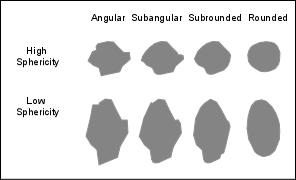
Sediment Maturity
Sediment Maturity refers to the length of time that the sediment has been in the sedimentary cycle. Texturally mature sediment is sediment that is well rounded, (as rounding increases with transport distance and time) and well sorted (as sorting gets better as larger clasts are left behind and smaller clasts are carried away. Because the weathering processes continues during sediment transport, mineral grains that are unstable near the surface become less common as the distance of transport or time in the cycle increases. Thus compositionally mature sediment is composed of only the most stable minerals.
For example a poorly sediment containing glassy angular volcanic fragments, olivine crystals and plagioclase is texturally immature because the fragments are angular, indicating they have not been transported very far and the sediment is poorly sorted, indicating that little time has been involved in separating larger fragments from smaller fragments. It is compositionally immature because it contains unstable glass along with minerals that are not very stable near the surface - olivine and plagioclase.
On the other hand a well sorted beach sand consisting mainly of well rounded quartz grains is texturally mature because the grains are rounded, indicating a long time in the transportation cycle, and the sediment is well sorted, also indicative of the long time required to separate the coarser grained material and finer grained material from the sand. The beach sand is compositionally mature because it is made up only of quartz which is very stable at the earth's surface.
Types of Clastic Sedimentary Rocks
We next look at various clastic sedimentary rocks that result from lithification of sediment.
Conglomerates and Breccias
Conglomerate and Breccia are rocks that contain an abundance of coarse grained clasts (pebbles, cobbles, or boulders). In a conglomerate, the coarse grained clasts are well rounded, indicating that they spent considerable time in the transportation process and were ultimately deposited in a high energy environment capable of carrying the large clasts. In a breccia, the coarse grained clasts are very angular, indicating the the clasts spent little time in the transportation cycle.
Sandstones
A Sandstone is made of sand-sized particles and forms in many different depositional settings.
Texture and composition permit historic interpretation of the transport and depositional cycle and sometimes allows determination of the source. Quartz is, by far, the dominant mineral in sandstones. Still there are other varieties. A Quartz arenite – is nearly 100% quartz grains. An Arkose contains abundant feldspar. In a lithic sandstone, the grains are mostly small rock fragments. A Wacke is a sandstone that contains more than 15% mud (silt and clay sized grains).. Sandstones are one of the most common types of sedimentary rocks.
Mudrocks
Mudrocks are made of fine grained clasts (silt and clay sized) . A siltstone is one variety that consists of silt-sized fragments. A shale is composed of clay sized particles and is a rock that tends to break into thin flat fragments (See figure 7.6e in your text). A mudstone is similar to a shale, but does not break into thin flat fragments. Organic-rich shales are the source of petroleum.
Fine grained clastics are deposited in non-agitated water, calm water, where there is little energy to continue to transport the small grains. Thus mudrocks form in deep water ocean basins and lakes.
Source: https://www2.tulane.edu/~sanelson/eens1110/sedrx.htm
0 Response to "Rocks That Are Easy to Erode Often Create"
Postar um comentário